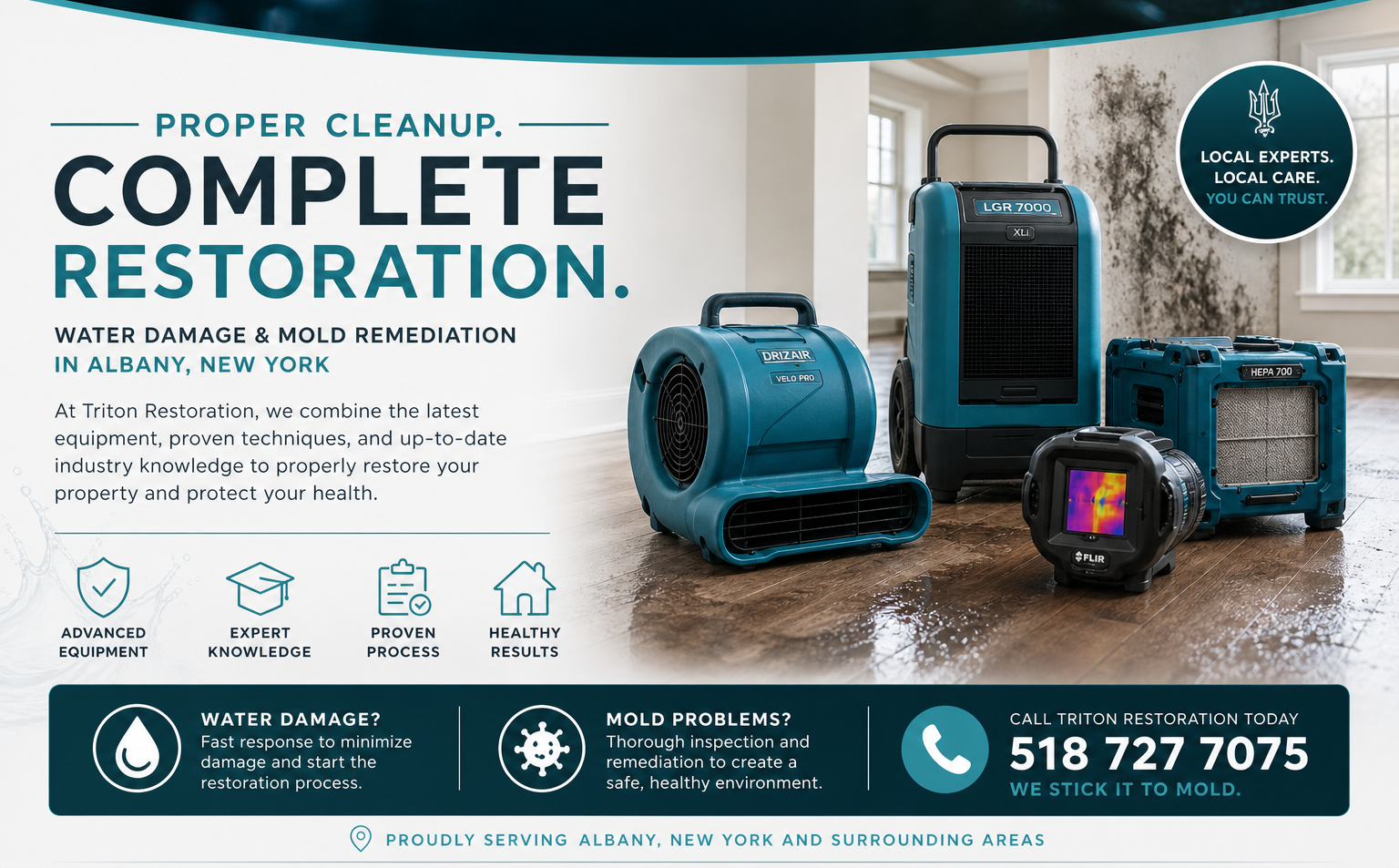
COMPLETE
RESTORATION.
Water Damage & Mold Remediation
in the Capital Region
At Triton Restoration, we combine the latest equipment, proven techniques, and up-to-date industry knowledge to properly restore your property and protect your health.
We work with third-party mold inspectors.
Triton partners with licensed third-party mold inspectors and indoor air-quality specialists for both pre-remediation assessments and post-remediation clearance testing. You get unbiased lab results — not a self-graded report card — so you know your property is genuinely safe.
- → Independent pre-job inspections
- → Lab-analyzed air sampling
- → Third-party clearance testing
- → Documented chain of custody
LGR dehumidifiers, HEPA filtration, thermal imaging.
IICRC-certified technicians on every job.
Inspection, containment, remediation, verification.
Independent post-remediation clearance testing.
Built on protocol. Backed by proof.
Every job follows IICRC S520 mold remediation and S500 water damage standards — led by a certified specialist, independently verified by third-party inspectors, and documented from start to finish.
Certified Specialists
IICRC-certified technicians trained in containment and HEPA filtration protocols.
Same-Day Response
Emergency crews dispatched throughout the Capital Region — Albany, Schenectady, Troy, and Saratoga.
Guaranteed Results
Independent post-remediation testing on every job. We don't leave until your air is clean.
Two standards. One playbook.
Every project follows the ANSI/IICRC S500 Standard for Water Damage Restoration and S520 Standard for Professional Mold Remediation — the benchmarks every reputable restoration contractor in the country is held to.
Water Damage Process
Rapid mitigation to stop damage, dry the structure, and prevent secondary mold growth.
Emergency Response
Same-day arrival, safety assessment, and immediate water extraction with truck-mounted and portable units.
Source Control
Identify and stop the active water intrusion — burst pipes, roof leaks, appliance failures, or sewage backups — before mitigation begins.
Moisture Mapping
Thermal imaging and calibrated moisture meters document the full extent of saturation behind walls, under flooring, and in cavities.
Controlled Demolition
Non-salvageable wet materials are removed per S500 Category 1/2/3 water classification to expose structural assemblies for drying.
Structural Drying
LGR dehumidifiers, air movers, and heat drying systems return materials to dry standard, monitored daily with documented readings.
Verification & Sign-Off
Final moisture readings confirm dry standard is met across all affected materials before the file is closed and rebuild begins.
Mold Remediation Process
Containment-first remediation, independently verified by third-party clearance testing.
Independent Assessment
Third-party inspector identifies the moisture source, maps affected materials, and collects baseline air and surface samples for lab analysis.
Containment
Affected areas are sealed with 6-mil poly barriers and placed under negative air pressure using HEPA-filtered air scrubbers to prevent cross-contamination.
Source Control
We locate and stop the underlying water intrusion — leaks, condensation, or vapor drive — because remediation without source control will fail.
Removal & Cleaning
Non-salvageable porous materials are double-bagged and disposed of. Semi-porous and structural materials are HEPA-vacuumed, damp-wiped, and treated per S520.
Drying & Restoration
Structural drying with LGR dehumidifiers and air movers brings moisture content back to dry standard, verified with calibrated meters.
Clearance Testing
An independent third-party inspector returns for post-remediation verification — visual, moisture, and air sampling — before any rebuild begins.
Request your free quote.
Tell us where you're located, what kind of property you have, and what you're seeing. A Triton specialist will follow up within the hour to schedule your on-site assessment.